
Market updates
Gas market price trends, realised prices and previous market updates in one place.
Gas market conditions and price developments
This page brings together Auris Energy’s gas market updates, TTF Front Month price data and previous years’ market history in one editable resource.
The situation at a glance
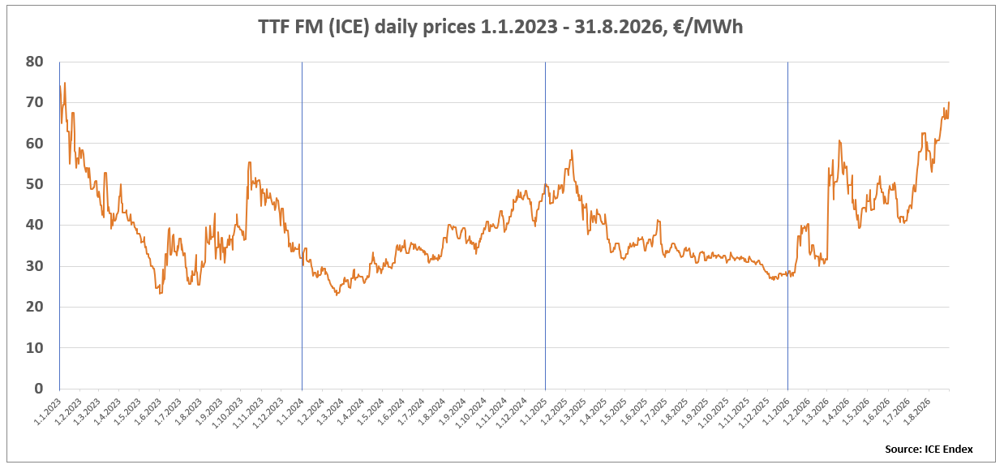
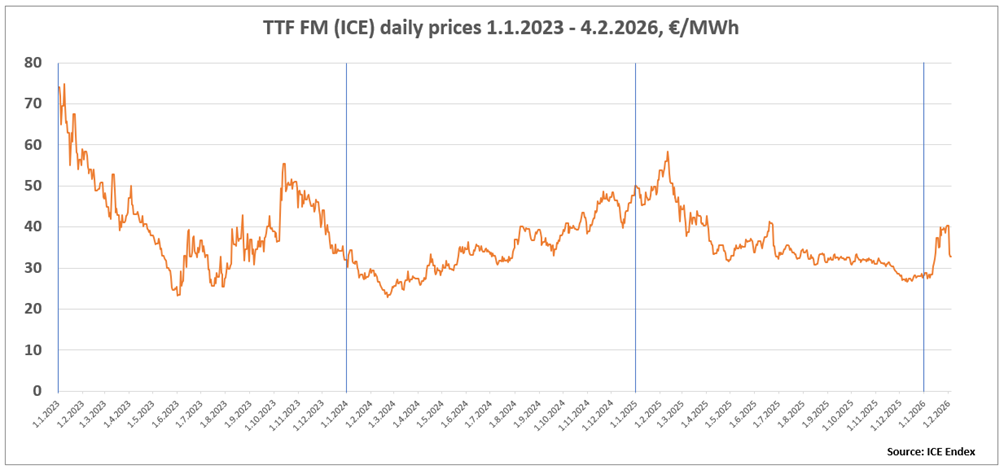
Market overview (updated 1 September 2026): Disruptions in the Strait of Hormuz continue to create uncertainty in gas markets. The daily TTF price rose above €70/MWh on 31 August. EU gas storage is around 65% full, compared with a five-year average of 82% for this time of year. Forward prices for the coming years remain clearly below near-term prices, but progress in negotiations and the near-term direction of prices remain difficult to assess.
This year’s updates
The latest situation is summarised at the top of the page. Open an individual update for more background or to compare how the market has changed during the year.
Update: 1 September 2026
Update: 1 September 2026
The memorandum of understanding (MoU) agreed between the United States and Iran on 17 June briefly eased concerns in international energy markets by opening the Strait of Hormuz to LNG vessels and other shipping. Markets interpreted the agreement as a sign of easing geopolitical tensions, and shipping through the strait recovered quickly. However, the situation deteriorated again in early July when the United States launched a series of overnight military strikes on Iran. Traffic through the Strait of Hormuz came to an almost complete halt again. At the time of writing, traffic has not recovered, with only individual oil and LNG vessels able to pass through the strait.
In the first week of August, markets received positive news about negotiations between Iran and Oman aimed at reopening the Strait of Hormuz. The news briefly brought daily TTF gas prices down to around €54/MWh, but continuing uncertainty quickly pushed them back above €60/MWh. The United States and Iran exchanged strikes on the last weekend of August, causing prices to rise above €70/MWh on Monday 31 August.
European gas forward prices for the rest of the year and the first quarter of 2027 are around €70/MWh. Forward prices for spring and the rest of 2027 are around €45–48/MWh. Forward prices for 2028 are €34/MWh and for 2029 around €27/MWh.
Gas storage is filling, but remains below average
The pace of gas storage filling in Europe will be an important factor affecting gas prices during the remainder of the year. EU storage is currently around 65% full. This is well below the five-year average of 82% for this time of year. Storage was 77% full at the same point last year.
Low storage levels mean Europe needs to fill storage as much as possible during late summer and autumn. The target is to reach 80% before the heating season begins. Markets currently consider this unlikely, which is reflected in prices for the rest of the year and the first quarter of 2027.
Reduced LNG supply to Asia increases competition for deliveries
The situation in the Strait of Hormuz means Asian gas buyers are competing with European buyers for LNG shipments from the United States. The price spread between the Asian JKM gas benchmark and TTF, which sets European prices, is not significantly wider than normal. Even so, it is sufficient to sustain competition for LNG cargoes and limit Europe’s ability to increase storage levels quickly.
The spread between spot and winter futures prices is unusually narrow
The small difference between current gas market prices and futures prices for the coming winter is somewhat unusual. The current market price, or spot price, is set in short-term gas trading. The winter price, in turn, reflects the price at which gas is expected to be purchased for winter delivery.
Markets typically price in a clear additional risk premium for winter, but spot prices and prices for the coming winter delivery periods are currently close to one another. This suggests that the market sees gas availability remaining tight in the near term and expects the situation to ease before winter begins.
The problem is that this small spread, which is currently even negative, does not encourage market participants to fill Europe’s gas storage facilities.
The longer-term outlook remains more moderate
The price outlook for the coming years remains significantly below current market levels. Market participants expect new LNG production projects in the United States, Qatar and other countries to increase supply substantially towards the end of the decade. Long-term forward prices are therefore clearly below near-term prices.
In the market’s view, the current relatively high price level is primarily due to temporary supply constraints caused by the situation in the Persian Gulf, low European storage levels and the risk of a cold winter, rather than a permanent structural gas shortage.
At present, however, both progress in negotiations over the Strait of Hormuz and the near-term direction of gas prices remain difficult to assess.
Pekka Karinen
Director, Gas Sales
Update: 23 June 2026
Update: 23 June 2026
On 17 June, the United States and Iran signed a memorandum of understanding (MoU) aimed at bringing the Middle East conflict closer to an end. Under the MoU, the parties aim to negotiate a final settlement to end the war within 60 days. They also agreed to extend the ceasefire by 60 days and immediately open the Strait of Hormuz to tankers and other shipping.
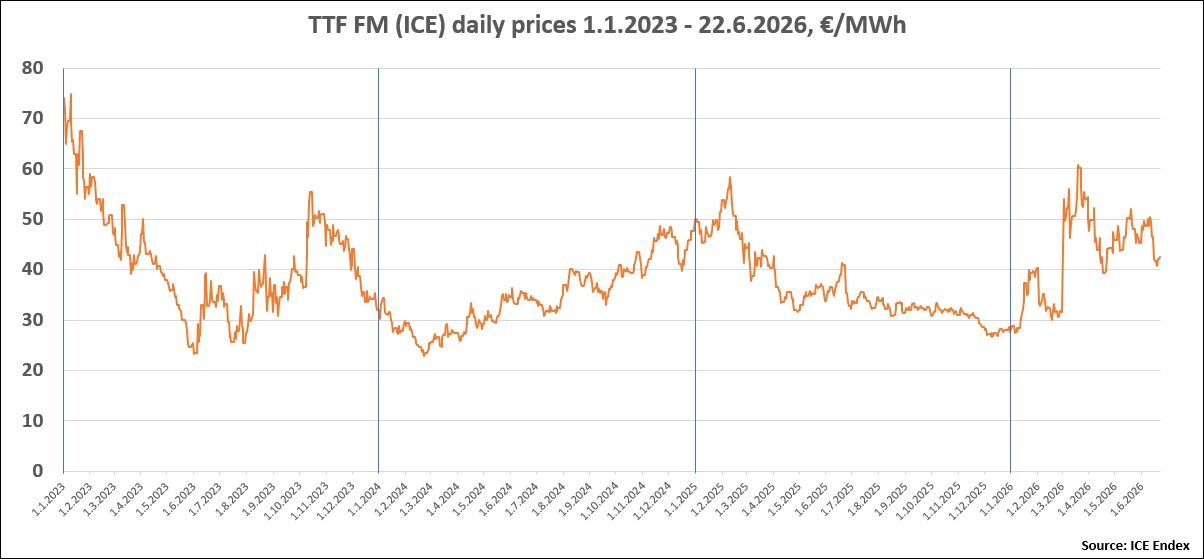
European gas exchange prices had already eased following the ceasefire that began in early April. Daily Front Month prices on the Dutch TTF exchange, which reflect the price for the following month, ranged from €40 to €52 per megawatt-hour after the ceasefire. Following the memorandum, gas prices fell from around €50/MWh before the signing to around €40–42/MWh.
Gas storage levels are rising despite the challenges
The memorandum was quickly put to the test when, over the weekend following its signing, Iran accused Israel of violating the ceasefire in Lebanon and announced that it would close the Strait of Hormuz again. The near-total closure of the strait at the beginning of the war cut off around one-fifth of global liquefied natural gas (LNG) deliveries. This has increased pressure on European gas companies to compete particularly with Asian buyers as the storage filling season gets under way.
Despite the challenging situation, European gas storage levels have risen at an almost normal pace during the spring and are now around 47%. However, they remain well below the five-year average of around 61% and last year’s level of 56% at the same time. This is due to the low starting level. The EU’s target is to bring storage levels to 80% by December.
Negotiations are progressing and shipping is picking up again
As of 23 June, the outlook for negotiations with Iran again appears more positive than over the preceding weekend. According to US Vice President JD Vance, progress has been made in the negotiations. Iran has, among other things, agreed to allow nuclear inspectors into the country and to develop mechanisms for handling frozen assets and monitoring ceasefires. Vance also mentioned a mechanism to keep the Strait of Hormuz open. Technical negotiations are expected to continue in the coming days and weeks.
As negotiations have progressed, shipping through the Strait of Hormuz has picked up again. Qatar Energy, the largest LNG producer in the Persian Gulf, has said it will bring production at Ras Laffan up to 50% of capacity within a month and around 80% within two months if shipping through the strait returns to normal.
Uncertainty sustains price volatility, but markets expect prices to fall
Uncertainty about progress in the negotiations keeps gas markets sensitive to price movements, particularly for the rest of the year and the first quarter of 2027. Forward prices for these periods are currently around €41–42/MWh. After that, markets expect prices to fall significantly. Forward prices for the period after the first quarter of 2027 are around €32–33/MWh.
Throughout the crisis, long-term forward prices have remained clearly lower and more stable than prices for the coming months. The price of the 2028 calendar product is around €28/MWh, the 2029 product around €24/MWh and the 2030 product around €22/MWh. The downward pressure on prices is primarily due to growing global LNG production capacity. The Persian Gulf crisis has therefore postponed the expected fall in prices by around a year.
Pekka Karinen
Director, Gas Sales
Update: 24 April 2026
Update: 24 April 2026
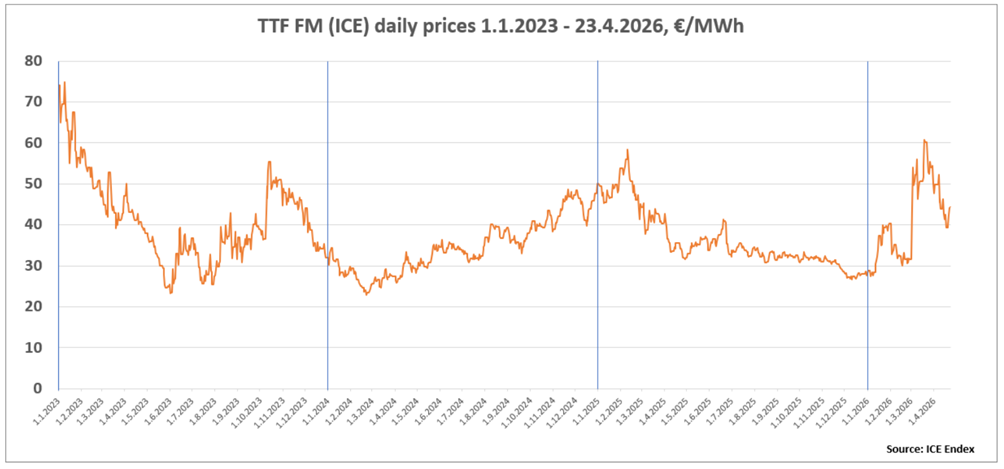
Following US and Israeli strikes on Iran, daily TTF gas exchange prices quickly rose from around €30/MWh to €50/MWh. From the beginning of March, daily prices ranged from €47 to €61/MWh until 8 April, when the ceasefire brought them down to €45/MWh. Since then, daily prices have ranged from €39 to €46/MWh.
Uncertainty remains in European gas markets, making near-term price developments difficult to assess. Most LNG deliveries to Europe come from the United States and Norway, and the situation in the Strait of Hormuz has had no direct impact on deliveries. However, increased interest from Asian buyers in LNG cargoes intended for Europe has affected European exchange prices.
An inverted summer–winter price spread is slowing storage filling
Low European gas storage levels are also maintaining market pressure. Storage is around 31% full, well below the five-year average of 43%. However, warm weather in Europe meant storage levels barely fell in March, and they have now started to rise.
Storage filling is currently held back by an inverted summer–winter price spread. Because of the Iran crisis, forward prices for next winter are unusually below current spot prices, making storage uneconomic. Winter prices would need to be at least a few euros higher than spot prices to cover storage costs. Next winter’s forward prices are currently €1–2/MWh below spot prices.
Prices may continue to fluctuate in the coming months
The near-term price direction remains difficult to predict. Gas prices have stayed relatively moderate given the scale of the crisis (see the price chart below). If the Persian Gulf situation continues to stabilise and LNG transport returns to normal, prices could quickly fall below €35/MWh.
If uncertainty continues, daily price volatility on European gas exchanges is likely to remain high, and the risk of prices rising above €50/MWh again remains.
The two-week ceasefire that began on 8 April has been extended, but negotiations between the United States and Iran still appear challenging.
Pekka Karinen
Director, Gas Sales
Update: 13 March 2026
Update: 13 March 2026
Daily gas exchange price volatility has increased significantly since the end of February. The escalation of the dispute between the United States and Iran into war has increased market uncertainty, compounded by concerns about energy shipments passing through the Strait of Hormuz.
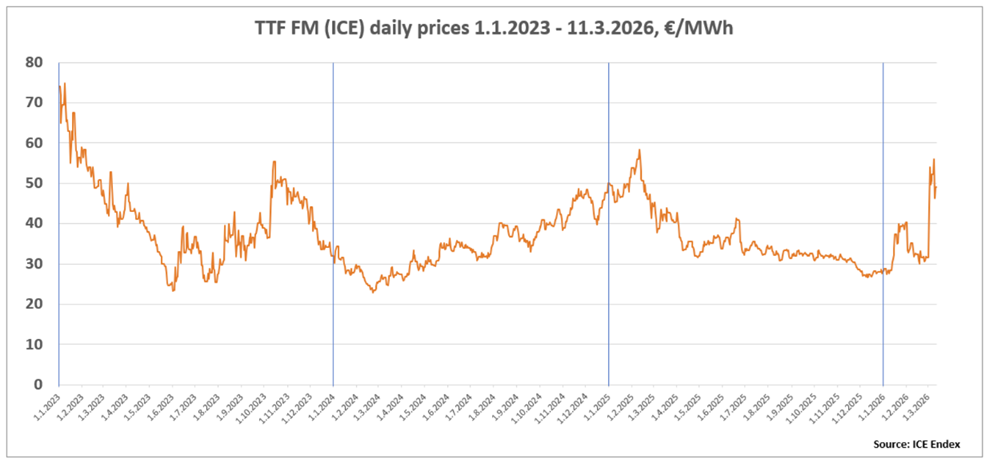
Daily prices on the Dutch TTF gas exchange rose in early March from around €32/MWh to around €55/MWh. They have since ranged from €46 to €56/MWh and are now around €50/MWh.
Most European LNG comes from the US and Norway
LNG from the Persian Gulf is destined for Asian markets. Europe’s LNG mainly comes from the United States and Norway, so problems in the Strait of Hormuz have no direct short-term effect on deliveries to Europe. If the situation persists, Asian gas buyers will begin competing for LNG cargoes intended for Europe, raising European exchange prices.
Low European underground gas storage levels are making the situation more difficult. Storage is currently around 29% full, compared with a five-year average of 43% at this time of year. A year ago, it was around 36%.
However, warm weather in Europe means storage levels have not fallen further in March. Gas demand will also decline as spring arrives.
Price volatility may continue in the coming months
At the time of writing (12 March), the market is pricing gas for the second quarter of 2026 at around €50/MWh and the third and fourth quarters at around €48–49/MWh.
Longer-term futures prices are lower. The calendar-year price is around €37/MWh for 2027, €26/MWh for 2028 and €23/MWh for 2029.
The direction of gas prices is currently very difficult to assess. If oil and LNG tankers begin passing through the Strait of Hormuz, gas prices could fall quickly. If the situation persists, daily European gas exchange prices are likely to remain volatile, with a risk of higher near-term prices.
Updated: 5 February 2026
Updated: 5 February 2026
Daily European gas exchange prices rose in January as the weather turned colder. Daily TTF prices on the Dutch ICE exchange increased from a low €27–28/MWh at the start of the year to around €38–39/MWh in the second half of January.
The rapid rise was supported by below-normal European storage levels and unusually cold weather in the United States, where gas intended for LNG production and export was diverted to pipeline gas markets.
Thanks to low prices in early January, however, February’s ICE TTF Front Month price, the monthly price commonly used in gas billing, remained relatively moderate at €33.64/MWh.
Milder weather forecasts pushed prices down in early February
European long-range weather forecasts became milder in the first week of February, bringing daily March Front Month prices down to €33/MWh within a couple of days.
Weather forecasting has been unusually difficult this winter because of a weak polar vortex. Cold air above the North Pole has not stayed in place but has periodically moved further south than usual in Europe and North America, causing sudden cold spells.
Forward prices point to moderate price developments
Forward prices for spring and the rest of the year are currently €31–32/MWh, a more moderate increase than in daily prices.
January’s price fluctuations have also had little effect on longer-term forward prices. Prices indicate around €26/MWh for 2027, €23/MWh for 2028 and below €22/MWh for 2029. The latter are already close to the long-term average gas price before the energy crisis.
European gas storage is currently around 41% full, compared with a five-year average of 58% at this point in winter. Low storage levels will keep the market tight through late winter and spring. This increases the risk of price rises if European weather forecasts turn colder than normal or other negative market surprises occur.
Price developments resemble last winter
Current gas price developments resemble last winter in many ways. Cold weather and low storage levels pushed daily prices up from early January to nearly €60/MWh by mid-February, before they quickly fell to around €40/MWh and then €35/MWh.
This year’s price movements have so far been much more moderate, despite storage levels being lower than last winter.
In summer 2025, daily gas prices briefly rose to around €40/MWh following the conflict between Israel and Iran, then fell back to €34–35/MWh as the situation stabilised. Prices remained stable at €32–35/MWh during autumn and fell towards €27–28/MWh at year-end.
Price stability was supported by milder-than-normal European weather, strong Norwegian pipeline gas flows and good global LNG availability. Weak EU industrial gas use due to economic conditions and increasing wind and solar power also weighed on prices.
An LNG-based market has changed price dynamics
European gas market dynamics changed when Russian pipeline gas was replaced by globally sourced LNG during 2022–2023. Before that, gas in Europe was usually clearly more expensive in winter than in summer because of bottlenecks in transmission connections from Russia.
In an LNG-based market, the global balance of supply and demand, geopolitical risks and events have a broader influence on gas prices. At the same time, lower European gas consumption has reduced seasonal fluctuations.
EU finally agrees a ban on Russian gas imports
During 2025, the EU prepared a ban on Russian LNG and pipeline gas imports, progressing despite opposition from some Member States. It received final approval on 26 January 2026 with support from a majority of Member States.
The ban does not take effect immediately; existing contracts were granted transition periods. Short-term contracts concluded before 17 June 2025 may continue until 25 April 2026 for LNG and 17 June 2026 for pipeline gas. Long-term LNG contracts may remain valid until the end of 2026, and long-term pipeline gas contracts until 30 September 2027.
Pipeline gas flows from Russia to Europe have been quite limited since summer 2022, consisting of relatively small volumes through Türkiye. Russian LNG has continued to be imported into Belgium, France and Spain.
Despite the transition periods, the ban can be seen as a significant EU achievement.
Gas has once again secured Finland’s energy supply
Daily gas prices in the Finnish market area have risen above Baltic prices because of cold weather, high electricity prices and the limited capacity of the Balticconnector pipeline linking Finland and Estonia.
Despite very high gas consumption, Finland’s gas transmission network has remained stable. Daily consumption peaks have reached 120 GWh, and gas has once again demonstrated its vital role in securing Finland’s energy supply.
Pekka Karinen
Director, Gas Sales
Realised prices
The table brings together the TTF prices mentioned in the updates. The type of price is shown separately: a daily price or range is not a realised monthly price. The figures describe the dates of the updates, not live market prices. Forward forecasts are included in the update texts.
| Period | TTF price | Type of price |
|---|---|---|
| 31 August 2026 | above €70/MWh | Daily TTF price; update of 1 September 2026 |
| June 2026 | around €40–42/MWh | Daily TTF price level after the memorandum signed on 17 June; update of 23 June 2026 |
| April 2026 | €39–46/MWh | Daily TTF price range following the ceasefire; update of 24 April 2026 |
| March 2026 | around €50/MWh | Daily TTF price level; update of 13 March 2026 |
| February 2026 | €33.64/MWh | TTF Front Month monthly price |
| September 2025 | around €33/MWh | TTF price level; update of 18 September 2025 |
| July 2025 | €37.12/MWh | Provisional TTF FM monthly price as at 25 June 2025; not the final monthly price |
| June 2025 | €35.19/MWh | Realised TTF FM monthly price |
| May 2025 | €35.61/MWh | Realised TTF FM monthly price |
| April 2025 | €41.96/MWh | Realised TTF FM monthly price |
| March 2025 | €50.71/MWh | Realised TTF FM monthly price |
| February 2025 | €48.13/MWh | Realised TTF FM monthly price |
| January 2025 | €45.07/MWh | Realised TTF FM monthly price |
| December 2024 | €43.75/MWh | Realised TTF FM monthly price |
| November 2024 | €40.36/MWh | Realised TTF FM monthly price |
| October 2024 | €36.24/MWh | Realised TTF FM monthly price |
Gas market history and archive
Older updates are retained in expandable sections. This keeps the history accessible and editable without the latest information getting lost in a long page of text.
View the 2025 market updates
Updated: 18 September 2025
European gas exchange prices have remained fairly stable through late summer and early autumn. Since late June, daily TTF Front Month prices, which also underpin Finnish gas pricing, have ranged from €31 to €35/MWh. September’s price level is around €33/MWh.
Markets expect prices to remain moderate
At the time of writing, TTF forward prices for the rest of 2025 are €33–34/MWh. Prices of around €34/MWh are expected for the first quarter of 2026 and €31–32/MWh for the rest of 2026. The current forecast for 2027 is also around €30/MWh and for 2028 around €27/MWh.
Gas storage levels below last year
European underground gas storage is currently 80% full. The five-year average for this time of year is 87%, while the level a year ago was 93%.
On 25 June, the European Parliament and Member States decided to retain the 90% gas storage target. However, Member States may deviate by 10 percentage points in difficult market conditions. The target may be met flexibly between 1 October and 1 December, and the filling obligation has been extended to the end of 2027. The market is confident that storage will reach the required level by early December.
Updated: 25 June 2025
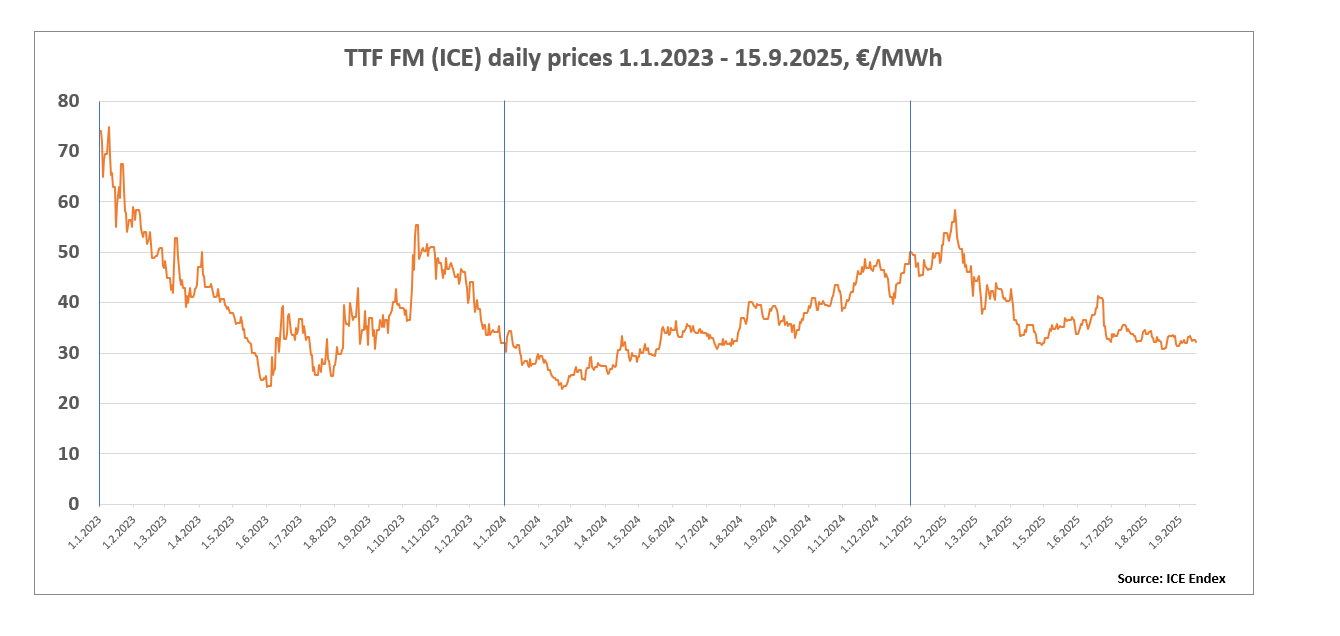
Daily TTF Front Month gas exchange prices have ranged from €32 to €43/MWh since March. The current daily July TTF FM quote is around €36/MWh. The price fell by around €5/MWh following the Israel–Iran ceasefire that began on 24 June 2025.
June’s TTF FM (ICE) monthly price was €35.19/MWh, and the almost fully determined July monthly price is currently €37.12/MWh (25 June 2025).
Markets expect prices to fall over the long term
TTF forward prices for the rest of 2025 are €36–38/MWh. Prices are around €37/MWh for the first quarter of 2026 and €34/MWh for the rest of that year.
Prices of €30/MWh are forecast for 2027 and around €26/MWh for 2028.
Geopolitics has driven gas price volatility
The Israel–Iran conflict has increased geopolitical risk and moved daily European gas exchange prices. Prices peaked at around €42/MWh before falling to €36/MWh following the ceasefire that began on Tuesday 24 June 2025. The gas market has been monitoring the conflict and its effect on prices.
The conflict does not affect gas production, but a potential closure of the Strait of Hormuz would block LNG deliveries from the Persian Gulf, mainly to Asia. Reduced LNG availability in Asia would indirectly raise prices for cargoes destined for Europe as Asian countries began competing for them. The Strait of Hormuz has never been closed, and market participants have considered closure unlikely.
There is still plenty of time to fill gas storage
At publication, European underground gas storage is 56% full, compared with a five-year average of 66% and 75% at the same time last year. The EU no longer requires storage to be 90% full specifically at the start of November; the target can be met flexibly between October and early December. This has significantly eased filling pressure.
Under the updated rules, the 90% target is also no longer absolute. Member States may deviate by 10 percentage points if market conditions are difficult.
Plans to ban Russian gas have become clearer
The European Commission has published more details of its plan to phase out Russian pipeline gas and LNG completely by the end of 2027. Spot deliveries are intended to end by the end of this year, and all deliveries of Russian-origin gas by 1 January 2028. Very little Russian pipeline gas still flows into EU countries, and only through Türkiye, but LNG has continued to arrive in Belgium, France and Spain.
The ban is intended to be implemented through legislation, requiring approval by the European Parliament and at least 15 Member States representing more than 65% of the EU population. This would prevent individual countries from blocking it.
Updated: 16 May 2025
Daily gas exchange prices in April and May have fallen clearly from January and February levels. Over the past month, daily TTF Front Month prices have ranged from €31 to €36/MWh, compared with around €50/MWh early in the year.
The realised TTF Front Month monthly price was €41.96/MWh for April and €35.61/MWh for May. Forecasts for the rest of the year range from €35 to €37/MWh.
Gas prices have fallen amid hopes of progress in Ukraine’s peace process and fears of a global recession caused by trade tensions. The EU has also decided to reduce its early-November gas storage target from 90% to 83%.
Underground storage is currently 43% full, compared with a five-year average of 53% at this time of year and 65% a year ago. Large LNG arrivals have enabled European storage to fill faster than average.
The European Commission has also recently presented an initial plan to ban Russian LNG and pipeline gas imports by 2027.
Updated: 19 March 2025
Daily next-month (Front Month) quotes on Europe’s largest gas exchange, TTF, have ranged from around €38 to €60/MWh early this year. The realised TTF FM (ICE) price was €45.07/MWh for January 2025, €48.13/MWh for February and €50.71/MWh for March.
The 2025 price outlook as of March 19 is as follows: the partially determined April TTF FM price is €41.5/MWh; TTF forwards indicate €41/MWh for May–October and €40/MWh for November–December. Prices are expected to fall in 2026 to €35/MWh.
Daily gas exchange prices have been quite volatile in recent months. The Ukraine–Russia gas transit agreement expired at year-end as expected. Despite Russian gas flows through Ukraine ending, gas availability has remained good in the Hungary–Slovakia–Austria region.
In the first week of January, the daily TTF price fell from €50/MWh to around €45/MWh. Prices then rose steadily to almost €60/MWh by mid-February because of colder weather and high underground storage withdrawals. European long-range weather forecasts became warmer in mid-February, after which prices fell to the current €40–42/MWh.
European underground gas storage is currently around 35% full, compared with a five-year average of 48% at this time of year and 59% last year.
This winter’s key gas market factors have been colder-than-normal European weather, low storage levels and progress in discussions concerning peace negotiations in Ukraine.
View the 2024 market updates
Updated: 20 December (originally published 25 November 2024)
Daily next-month (Front Month) quotes on Europe’s largest gas exchange, TTF, have ranged from €33 to €49/MWh during autumn. The realised TTFI FM monthly reference price for exchange-linked gas products was €36.24/MWh in October, €40.36/MWh in November and €43.75/MWh in December. The current January TTFI FM forecast is €44.5/MWh (19 December 2024).
The 2025 price outlook is also fairly consistent. TTF forwards indicate €43/MWh for January–March and €41–43/MWh for the rest of the year. Prices are expected to fall to €36/MWh in 2026 and further to €30/MWh in 2027.
Daily gas exchange prices have remained fairly stable during autumn despite growing geopolitical risks. Ukraine’s counter-offensive into Russia’s Kursk region, through which gas still flows to Europe via Ukraine, raised daily prices by around €5/MWh in early August. Increased tensions and events in the Middle East have also had relatively little impact on daily prices. The US presidential election result did not affect gas prices, but Trump’s policies are seen as increasing US gas production over the long term and thereby lowering global LNG prices.
According to current information, the Ukraine–Russia gas transit agreement will expire at year-end. Over the past two years, Russian pipeline gas has flowed to Europe only through Ukraine and Türkiye, at around 400–500 GWh per day through each route. Expiry would therefore reduce Russian pipeline deliveries from around 1,000 GWh to around 500 GWh per day. Before Russia’s war of aggression, total daily pipeline deliveries from Russia to Europe, including Nord Stream and Yamal–Poland, were around 4,000 GWh. The market has long known about the agreement’s expiry, which is not expected to raise gas prices significantly.
A couple of rumours emerged during autumn suggesting that gas flows through Ukraine to Europe could continue. In recent days, reports have suggested negotiations are continuing on transporting Azerbaijani gas through Russia and Ukraine to Slovakia and Hungary. Whether flows through Ukraine continue after year-end remains to be seen, although it is unlikely. We would like to reiterate that Auris does not buy or sell Russian gas under any circumstances.
Underground gas storage levels are among the most important influences on European gas prices. Colder-than-normal weather in continental Europe over the past four weeks reduced storage levels and raised daily Front Month prices from €42/MWh to nearly €50/MWh. European weather has now warmed, with long-range forecasts indicating above-normal temperatures well into January. More LNG cargoes are also arriving than in recent weeks. Mainly as a result, daily Front Month and next year’s forward prices have fallen to €40–43/MWh in recent days. European underground storage is around 78% full, close to the five-year average. Storage levels are not expected to fall much before year-end, allowing the new year to start at reasonably high levels.
Finland’s gas supply outlook for the coming winter is good. The Balticconnector pipeline linking Finland’s gas market to the Baltics, repaired in April, has operated normally. Its capacity of around 70 GWh/day comfortably meets Finland’s gas needs on normal winter days. According to Gasgrid Finland, LNG cargoes are scheduled to arrive at the Inkoo import terminal over winter. Together, these supplies comfortably cover Finland’s gas needs even on the coldest winter days.
Wishing you a peaceful and enjoyable Christmas season!
Pekka Karinen
Director, Gas Sales
Update: 29 May 2024
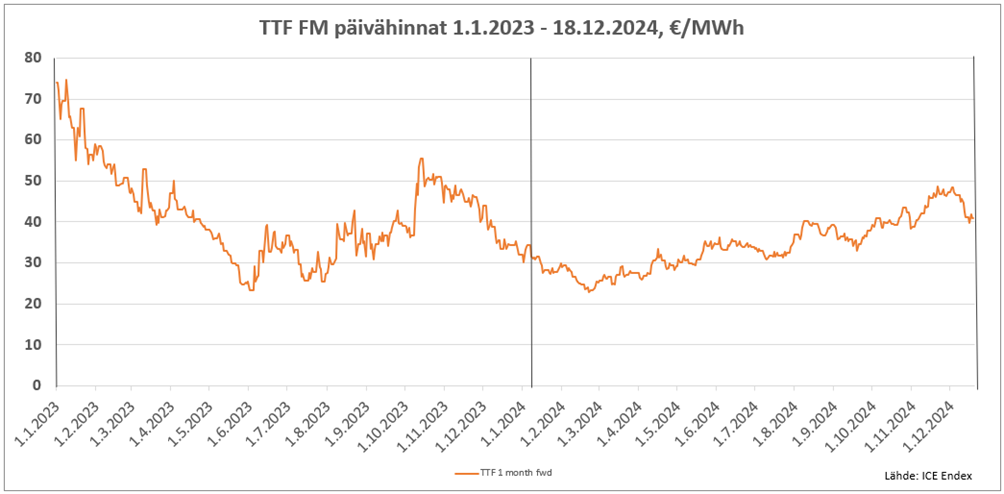
European gas exchange prices have remained between €23 and €35/MWh since mid-December 2023. The forecast for June is around €31/MWh. Prices for the rest of the year are forecast to range from €36 to €39/MWh.
EU gas storage levels remain high, currently 67% compared with a five-year average of 52%. Asian LNG demand has stayed low, global LNG availability is good and LNG vessel charter rates are low.
The Balticconnector pipeline linking Finland and Estonia has been repaired and available to the gas market since late April.
Update: 15 February 2024
Since our last update, gas exchange prices have remained between €27 and €30/MWh. The realised February TTF gas hub Front Month price is around €28/MWh (8 February 2024). Prices for the rest of the year are forecast to range from €28 to €31/MWh.
The same factors continue to keep gas prices moderate. European underground storage remains high for the season, at around 67% compared with a five-year average of around 52%. Weather forecasts have also continued to predict warmer-than-normal European weather.
In Finland, the Inkoo LNG terminal has performed well and the gas market has remained balanced. Gasgrid Finland still expects the Balticconnector pipeline linking Finland and Estonia to return to service during April 2024.
Update: 19 January 2024
Gas exchange prices have remained between €30 and €35/MWh over the past month. The forecast February TTF Front Month price is around €31/MWh (17 January 2024). Prices for the rest of the year are currently forecast to range from €28 to €32/MWh.
High underground storage levels and forecasts of a warmer-than-normal winter have continued to keep gas prices moderate.
In Finland, the Inkoo LNG terminal has performed well and the gas market has remained balanced. Gasgrid Finland still expects the Balticconnector pipeline linking Finland and Estonia to return to service during April 2024.
View the 2023 market updates
Update: 21 December 2023
European gas exchange prices fell significantly during November and December. The forecast January TTF Front Month price is now around €37/MWh. Next year’s gas prices are currently forecast to range from €33 to €38/MWh.
Prices have fallen in recent weeks because European underground storage levels remain very high and weather forecasts predict a warmer-than-normal winter. At the time of writing, storage is around 88% full, compared with a five-year average of 76% for this time of year.
European gas prices have also been restrained by factors including substantial increases in LNG import capacity in several European countries since the war in Ukraine began.
Update: 25 October 2023
The European gas market reacted to global political events in October, but price increases have been fairly moderate. Daily Front Month prices ranged from €30 to €55/MWh in September and October. The current November TTF Front Month monthly forecast is around €45/MWh. Prices of around €55/MWh are forecast for winter and next summer.
The main reason for higher European gas prices is the Hamas–Israel conflict, which has increased geopolitical risk in energy markets. The threat of strikes at Chevron’s Australian LNG facilities throughout autumn has also increased European gas price volatility. Employers and employees have just reached an agreement, removing the strike threat.
Very high European underground storage levels, around 98%, have restrained price increases. The relatively high €50–55/MWh forecast for next summer reflects uncertainty about how cold and long winter will be and how far storage will be depleted. One estimate suggests that storage falling below around 46% would significantly increase Europe’s LNG import requirements compared with this year.
Finland’s transmission system operator Gasgrid Finland and Estonia’s Elering detected an unusual pressure drop in the subsea gas pipeline linking Finland and Estonia on 8 October 2023. The valves were closed immediately, and no gas currently flows through the pipeline between the countries. Investigations revealed damage that will take at least until next April to repair. Auris is following the Balticconnector situation here.
Despite the damaged pipeline, Finland’s gas market remains stable. Gas enters through the LNG terminal in Inkoo and smaller terminals such as Hamina. Inkoo’s capacity is sufficient to secure all Finnish gas consumption, including higher winter demand.
Update: 15 September 2023
September’s gas market has largely resembled August. The realised September TTF Front Month price was around €35/MWh. A similar level is forecast for October.
The current TTF forward price is €46/MWh for November and €51/MWh for December.
Next year’s prices are forecast at around €52–55/MWh.
Update: 22 August 2023
European gas exchange prices fluctuated somewhat during summer, but daily prices remained reasonable at around €25–40/MWh.
The current September TTF forecast is around €34/MWh (21 August). Monthly gas forward prices rise to €40–55/MWh towards year-end.
Prices for the whole of next year are currently forecast at around €53–56/MWh.
Gas storage is almost full
European underground gas storage is currently more than 90% full, a positive sign for the coming autumn and winter. The EU target was to reach 90% by early November.
The five-year average storage level at this time of year is around 77%. Last year, storage was 76% full at this point.
Gas price fluctuations remain greater than usual
Front Month monthly gas prices have stayed at almost the same level throughout summer, but remain much more volatile than before the war in Ukraine. Market and gas production events therefore move prices more readily than in the past.
One example came in early August, when daily Dutch TTF prices jumped from around €30/MWh to €40/MWh because of threatened strikes at Australian LNG production facilities. The market expected a strike could affect LNG availability as far away as Europe.
Despite historically greater market volatility, the coming winter’s outlook for gas prices and availability in Europe and Finland is stable. Underground storage levels are high and several new LNG import terminals have been completed in Europe. Replacing Russian gas with LNG has been very successful in Europe and in the Finland–Baltic market.
Update: 16 May 2023
European gas exchange prices have continued to fall since our last update. The realised TTF price was around €44/MWh for April and €42/MWh for May. At the time of writing, June’s forecast is around €35/MWh.
Gas prices have continued downwards for several reasons. A relatively warm winter and some gas users switching to oil and propane reduced winter gas demand.
European storage levels also remain high for the season, and the market believes refilling for next winter will be straightforward.
At the time of writing, the TTF forecast for autumn is around €50/MWh. The 2024 forecast fluctuates slightly either side of €50/MWh.
Update: 1 March 2023
European gas exchange prices continued to fall throughout February. Reasons still include exceptionally warm weather and high European storage levels.
Daily March Front Month quotes on the TTF exchange during February ranged from €47 to €60/MWh.
The current March Front Month index forecast is around €53/MWh (28 February).
Prices for the rest of the year are around €50/MWh
Summer prices are currently forecast at around €48/MWh. Gas prices for the rest of the year and next winter are also expected to remain significantly below last year’s levels, at around €45–57/MWh.
This is still significantly above the historical average of around €20/MWh, but the market nevertheless expects a much more stable year than last year.
Confidence in lower prices is supported by European storage remaining quite full after a warm winter. Storage is currently around 60% full, compared with an average of around 40% at this time of year. The market expects refilling for next winter to be relatively easy. Germany’s three new floating LNG receiving terminals will help, feeding ship-delivered gas into the grid in the same way as Finland’s newly commissioned floating LNG import terminal in Inkoo.
In theory, prices could still rise this year if LNG demand increased significantly in China following the lifting of coronavirus restrictions. Much of the LNG supplied by the United States, for example, has come to Europe while China’s demand has been low because of lockdowns.
On the other hand, gas prices are currently very close to oil prices. Some large gas users temporarily switched to oil because of last year’s record gas prices. Some have already switched back or are considering doing so, increasing gas demand and potentially slowing the price decline.
Update: 19 January 2023. European gas exchange prices fell significantly during December and January. Reasons include an exceptionally warm autumn and winter, apart from a cold spell lasting just over a week in early December, and high European gas storage levels.
Daily TTF Front Month prices fell in December from €140/MWh to around €70/MWh. January’s daily Front Month prices have ranged from €70/MWh down to around €55/MWh.
The current February gas exchange price forecast is around €66/MWh (18 January). Summer forward prices are around €60/MWh.
The floating terminal secures Finland’s gas supply
The LNG terminal vessel Exemplar arrived in Finland in December, moored at Inkoo harbour and was connected to the gas transmission network. It can now supply gas to Finland and the Baltics.
The vessel increased gas entry capacity into Finland’s gas system from around 60 GWh to more than 150 GWh per day.
A gas transmission pipeline exploded in Latvia last weekend. Current information indicates that it was an accident. It has not affected gas deliveries to Finland.
The European gas price cap is €180/MWh
EU energy ministers agreed on a gas price cap in December. Activation currently appears quite unlikely given market conditions.
In practice, the cap activates if the TTF price exceeds €180/MWh for more than three consecutive days and is also €35/MWh above a reference basket of LNG prices for deliveries to Europe, north-east Asia and the UK.
The price cap mechanism takes effect on 15 February and applies to all European gas exchanges. Its application may be suspended if, while active, gas demand rises by more than 15% in one month and 10% in two months, if European LNG imports fall significantly, or if trading volumes on the TTF exchange decline substantially.
View the 2022 market updates
Update: 28 October 2022
European gas exchange prices have continued to fall over the past two weeks. The main reasons remain the same as in our previous update: warm continental European weather, lower gas demand and very full European storage.
This week’s November TTF Front Month forecast is around €140/MWh, with December forward prices around €133/MWh (26 October).
Forward quotes indicate prices of around €130–140/MWh throughout next year, falling to around €94/MWh in 2024.
Update: 12 October 2022
European gas exchange prices have fallen significantly in recent weeks from the late-August peak above €300/MWh. The forecast for the rest of the year was still above €200/MWh in late September, but fell to around €160–170/MWh in two weeks.
The main reasons are high European underground storage levels of around 90% and reduced gas use in industry, the public sector and households. The drought-related electricity price spike that pushed gas prices up in late August has also eased.
Leaks were detected in the Nord Stream pipelines in late September
Major leaks were detected in the Nord Stream I and II pipelines from Russia to Europe in late September. They were located in the Swedish and Danish economic zones near Bornholm. Investigations have identified explosions as the cause.
Hamina terminal is ready and the LNG terminal vessel is on its way to Inkoo
Finland has taken two important steps forward in gas security of supply.
The Hamina LNG terminal and storage tank have been completed and have already received their first LNG cargoes. The large floating LNG receiving terminal leased by Gasgrid Finland is also travelling from South America towards Finland. Its market terms are expected to enter the Finnish Energy Authority’s public consultation in the coming days.
Early this week (10 October), it was confirmed that the vessel will spend its first winter on the Finnish side, at Inkoo harbour. It is expected to arrive in late December carrying LNG.
The vessel provides interim storage for imported LNG while it is regasified and fed into the gas transmission network. Its maximum regasification capacity is 140 GWh per day, with annual receiving capacity of up to 35 TWh. Finland’s total annual natural gas consumption has been around 25 TWh in recent years.
Update: 12 September 2022
European gas exchange prices have fluctuated in recent weeks, exceeding €300/MWh on several days. Prices nevertheless fell last week.
Forward prices for the rest of the year fell from around €250/MWh to €210–220/MWh. The main reasons were high continental European storage levels (83%), reduced industrial gas consumption and a warmer-than-seasonal weather forecast. TTF prices for next year are expected to decline gradually to around €180/MWh and to around €125/MWh in 2024.
Following Nord Stream I’s annual maintenance, completed in late July, Gazprom cut deliveries through the pipeline to Europe to just 20% of capacity. In late August, it halted deliveries for three days of maintenance. Deliveries did not resume afterwards, and no gas now reaches Europe through Nord Stream. Russia has cited technical problems, but the EU views the measures as pressure on Europe related to the war in Ukraine. Russian gas still reaches Europe through Ukraine and Türkiye.
The European Commission and energy ministers have discussed the need to cap gas prices and currently record-high electricity prices in recent weeks. No decision has yet been made, but one is expected soon. The EU aims to lower current energy prices ahead of winter.
Update: 4 August 2022
European gas exchange prices rose significantly in late July when Russia’s President Putin announced further Gazprom restrictions on Nord Stream I flows to Europe. Citing technical reasons, Russia cut deliveries from 40% to 20% of pipeline capacity. Flows through Ukraine remained unchanged.
In early August (3 August), gas exchange forward prices for September and the rest of the year are around €200/MWh. The latest price rise has few causes other than Russia’s reduction in Nord Stream I deliveries and market concern, especially in Germany, about further cuts.
European storage levels are already very high for the season thanks to substantial LNG imports, but refilling will become more difficult if Russian deliveries to Europe fall further.
Update: 21 July 2022
Scheduled annual maintenance of Nord Stream I began on 11 July and ended today. No gas flowed to Europe through the pipeline during maintenance, but deliveries towards Germany resumed today at the same rate as before. European gas exchange prices also moved slightly lower. Uncertainty remains over future Russian supplies. Flows are currently around 40% of Nord Stream I’s capacity.
We reiterate that Finland receives gas normally through the Baltics via Balticconnector, covering national consumption, as it also did during Nord Stream I maintenance. Nord Stream’s situation therefore affected Finland’s gas market only through price fluctuations. Next winter, the floating LNG terminal leased by Gasgrid Finland will further improve security of supply.
August’s SK index-based price is clearly below prices linked directly to TTF
Yesterday’s August Front Month index forecast on the Dutch TTF exchange was around €165/MWh (20 July). However, customers using our SK index will pay considerably less in August. The SK index-based gas price for August is around €120/MWh, excluding VAT.
TTF prices of around €160/MWh are forecast for the rest of the year. There is considerable market uncertainty, including how much gas Russia will send to Europe through Nord Stream in future.
Finland has already achieved the Commission’s proposed gas consumption reduction
The European Commission has proposed that Member States reduce gas consumption by 15% compared with normal years to improve Europe’s chances of filling storage before winter.
Finland’s gas consumption has already fallen by well over a quarter this year, comfortably exceeding the Commission’s target. Based on current information, the need for further consumption reductions therefore does not apply to Finland.
Update: 28 June 2022
Much has happened in gas markets over the past two weeks. European gas exchange prices began to rise when Russia reduced exports to Germany through Nord Stream I. A fire at a major US LNG production facility has also raised European gas prices.
Since Monday 27 June 2022, the Dutch TTF Front Month index forecast for July has been around €105/MWh. Forward prices for the rest of the year are currently around €130/MWh.
European gas markets have shown uncertainty about next winter. Reduced Russian supplies have slowed storage filling. Germany, for example, has begun preparing for a possible end to Russian gas flows to Europe. Plans to restrict industrial gas use and restart coal-fired power plants are being developed to secure supply. Meanwhile, the EU is seeking as much non-Russian LNG as possible.
Finland has sufficient gas, and a floating terminal will add security
Finland continues to receive enough gas through Balticconnector from the Baltics to cover national demand. There is therefore no need to restrict consumption, although Russian supplies to Finland ended in late May.
Next winter, the floating LNG terminal leased by Gasgrid Finland will improve Finland’s security of supply. Fortum’s Inkoo harbour was recently confirmed as its final location. The terminal will enable LNG imports from around the world. LNG will be regasified and fed into the gas grid.
The terminal is intended to enter service by next winter. It may spend its first winter in Estonia if the required harbour infrastructure is completed there before Finland’s. Its large capacity should alone cover all Finnish and Estonian gas demand. The Hamina LNG terminal also aims to start operating in October.
Update: 23 May 2022
Russian gas deliveries to Finland ended on Saturday 21 May 2022. This does not affect Suomen Kaasuenergia’s operations or deliveries. Even before the war in Ukraine, we imported almost all our gas from the Baltics. Gasgrid Finland Oy has also stated that all gas required by Finland’s market is now imported through Balticconnector from the Baltics. Finland’s gas system is therefore balanced and operating normally despite the closure of the Imatra entry point. Finland’s transmission system operator has agreed to lease a terminal vessel. On Friday, Gasgrid Finland also announced a ten-year agreement with Excelerate Energy to lease a floating LNG terminal. It will improve Finland’s security of supply and help the entire Finnish market move away from Russian gas. LNG delivered to the vessel will be regasified and fed into the natural gas transmission network. Its storage and send-out capacity is sufficient to secure Finnish and Estonian demand. The vessel is intended to enter service by next winter. Gas prices have fallen since last week. European exchange prices began declining last week, partly because European storage is filling quickly. At the current pace, storage will be almost full by the end of September and should cover even a very cold winter. The current June TTF Front Month forecast is around €95/MWh. Today (23 May), the TTF exchange price briefly fell to around €83/MWh. This is a developing article tracking the effects of the war in Ukraine on gas markets since the war began. Previous updates and the original text appear below.
Update: 18 May 2022
Several media outlets reported today that Russian natural gas flows to Finland could stop this week. As stated previously, we at Suomen Kaasuenergia believe we can supply all customers normally even if no Russian gas arrives.
This is because our diversified procurement relies mainly on gas transported to Finland through the Baltics. This includes LNG originating in countries such as the United States and Norway.
Update: 11 May 2022:
Gas deliveries to Finland and most of Europe continue normally from both the Baltics and Russia. European gas exchange prices are currently around €100/MWh. Yesterday’s June TTF forecast, for example, was around €98/MWh (10 May).
The gas Suomen Kaasuenergia sells to customers comes almost exclusively from the Baltics. Gas arrives there as LNG from various sources worldwide, but currently none from Russia.
The National Emergency Supply Agency’s early warning and Ukraine’s decision to stop Russian gas transit do not affect Suomen Kaasuenergia’s deliveries
Last week, Finland’s National Emergency Supply Agency issued an early warning to the European Commission about potential Finnish gas market disruptions. Declaring the early warning level changes nothing for Suomen Kaasuenergia or our customers.
Germany, for example, has had such an early warning level in place for weeks. The agency’s announcement simply means a gas market supply disruption is possible. This is because Finland, like many other countries, has refused Russia’s demand to pay for gas in roubles.
The disruption to Russian supplies mentioned in the warning is not currently affecting Finland’s gas market. Even if it occurs later, we do not expect it to affect Suomen Kaasuenergia’s customer deliveries. Almost all our gas comes from the Baltics. We therefore believe we can supply all customers normally even if no Russian gas arrives.
Yesterday and today, reports also stated that Ukraine has halted natural gas transit in a pipeline carrying gas from Russia through Ukraine to Europe. The news raised European exchange prices somewhat yesterday, but has so far had no effect on Suomen Kaasuenergia’s operations or general gas supply reliability in Finland.
Update: 4 May 2022
Gas deliveries to Finland continue normally from both Russia and the Baltics. Even before the war in Ukraine, Suomen Kaasuenergia procured most of its gas through the Baltics. This includes LNG originating in countries such as the United States and Norway.
Recent public discussion has considered whether Russia might stop selling gas to Finland. It intensified after Russia stopped selling to Poland’s PGNiG and Bulgaria’s Bulgargaz last week. Russia continues normal sales to other European gas companies and Finland. Finland also receives substantial volumes through Balticconnector from the Baltics.
Thanks to our diversified procurement, we at Suomen Kaasuenergia do not currently expect a halt in deliveries through Imatra to affect our customer supplies.
Gas prices remain exceptional
Gas exchange prices remain exceptionally high, although below their peak a few weeks ago. They also continue to fluctuate sharply from day to day and week to week. Dutch TTF prices are currently €95–100/MWh, with forecasts for the next two months also around €100/MWh.
EU energy ministers met at a crisis meeting on Monday 2 May. They largely agreed that a ban on Russian oil imports was likely. They also discussed that Russia’s demand for gas payments through the current rouble mechanism was unacceptable. We are actively monitoring the situation.
The GIPL pipeline connecting Poland and Lithuania entered service on 1 May. It physically links Finland and the Baltics to the European gas market and should further improve security of supply. Finland and Estonia are also jointly investigating the lease of a floating LNG terminal to further reduce dependence on Russian energy.
Update: 23 March 2022:
Gas deliveries to Finland and Europe continue normally, as at the previous update.
Gas prices during the war in Ukraine have been unprecedented, but exchange prices have fallen slightly this week and last week.
Yesterday’s April TTF forecast was around €137/MWh (22 March 2022). Despite the slight decline, prices remain historically exceptional at more than six times the long-term average of around €20/MWh.
Update: 8 March 2022:
The Russia–Ukraine war has not affected gas deliveries. Gas continues to flow normally to Europe, the Baltics and Finland. Finland receives gas through both the Imatra border point and Balticconnector as before, with no need to restrict consumption or deliveries. The Finnish and Baltic market receives gas from many sources, including US LNG.
The war in Ukraine and related uncertainty have pushed already historically exceptional gas exchange prices to unprecedented levels. Yesterday’s April TTF Front Month forecast was around €170/MWh (7 March 2022). Daily exchange price movements have also been unusual, reaching €50/MWh in a single day.
How the gas market operates during potential supply disruptions
Original text: 24 February 2022:
The Russia–Ukraine conflict, which has worsened in recent weeks and escalated into an invasion this morning, has raised many questions about gas deliveries to Finland. To serve our customers, we have compiled information below explaining how the gas market operates during different disruptions and how gas prices have developed.
We monitor gas markets daily and update this article regularly because there is currently considerable uncertainty. This morning’s attacks on Ukraine immediately moved gas exchange prices.
We emphasise that gas currently flows to Finland completely normally through both the Imatra border point and Balticconnector, which links the Baltics and Finland. There is no need to restrict consumption or deliveries.
Finland also receives gas from sources other than Russia
Some gas used in Finland still arrives directly from Russia through the Imatra border point. We do not currently believe Imatra would be among the first entry points to close if Russia restricted exports to Europe. However, any export restrictions would certainly affect Finnish gas prices, which are linked to central European gas exchange prices.
If gas flows through Imatra stopped, Finland could receive gas from the Baltics through Balticconnector beneath the Gulf of Finland. At temperatures above zero degrees, its capacity is sufficient to cover almost all current Finnish gas use.
Latvia also has a large underground gas storage facility with capacity equivalent to Finland’s annual consumption. Lithuania has a commercially operated, open-access LNG import terminal capable of bringing significant volumes from around the world into the combined Baltic and Finnish market.
This means Finland already receives significant gas volumes from sources other than Russia. In exceptional situations disrupting Russian supplies, the aim would be to increase these alternative volumes.
How the gas market operates during gas availability disruptions
In a major disruption affecting gas availability, transmission system operator Gasgrid Finland Oy would instruct suppliers to restrict deliveries if force majeure prevented them from procuring enough gas to meet customer requirements.
Even then, the starting point is to maintain supplies for customers paying the compulsory storage charge, namely households, heating users and transport users, for as long as possible.
Further information is available on the transmission system operator’s website here.
If exceptional circumstances required severe restrictions on gas use, the National Emergency Supply Agency would authorise the use of compulsory stocks. Suomen Kaasuenergia would then follow Gasgrid Finland’s and the authorities’ instructions on restricting deliveries and using operators’ compulsory stocks.
We nevertheless consider this situation very unlikely at present. Further information is available through the Gasgrid link above.
The Ukraine crisis is keeping gas prices high
European gas exchange prices have been exceptionally high for several months, although they fell from their peak after the end of last year. Since early January, the TTF Front Month index indicating next month’s gas price has remained at €70–95/MWh. The current March forecast is around €76–77/MWh (23 February). Daily exchange price movements remain large.
Many factors supporting high prices have eased as spring approaches. A warm winter has reduced gas consumption below normal and brought European storage closer to previous years’ levels. More LNG deliveries are also reaching Europe than towards the end of last year.
The Russia–Ukraine crisis is currently the main factor sustaining high gas prices and major market uncertainty. This morning’s attacks on Ukraine immediately raised exchange prices somewhat.
The effect of high gas prices on bills
We know that higher gas prices have significantly increased our customers’ bills. We have therefore offered payment by instalments. Our customer service team can explain the options.
Gas used by consumers is also covered by social assistance, if paying in instalments does not help.
The SK index used to price many of our gas products has also offered customers protection amid price fluctuations. SK index pricing is more stable than pricing linked directly to the exchange, because we hedge SK index prices during the three months before delivery. This smooths and delays price changes in gas bills, although it does not eliminate them entirely.