Valio and Auris have jointly implemented a reserve market solution that supports the stability of Finland’s electricity system and is also financially viable.
Valio’s Vaarala production plant has a long history. Its oldest sections were built in 1963. The factory makes products including processed cheeses and slices familiar Valio cheeses such as Oltermanni.
Despite its age, the plant has modern energy solutions, thanks to Valio’s open-minded approach to the opportunities created by changes in energy markets.
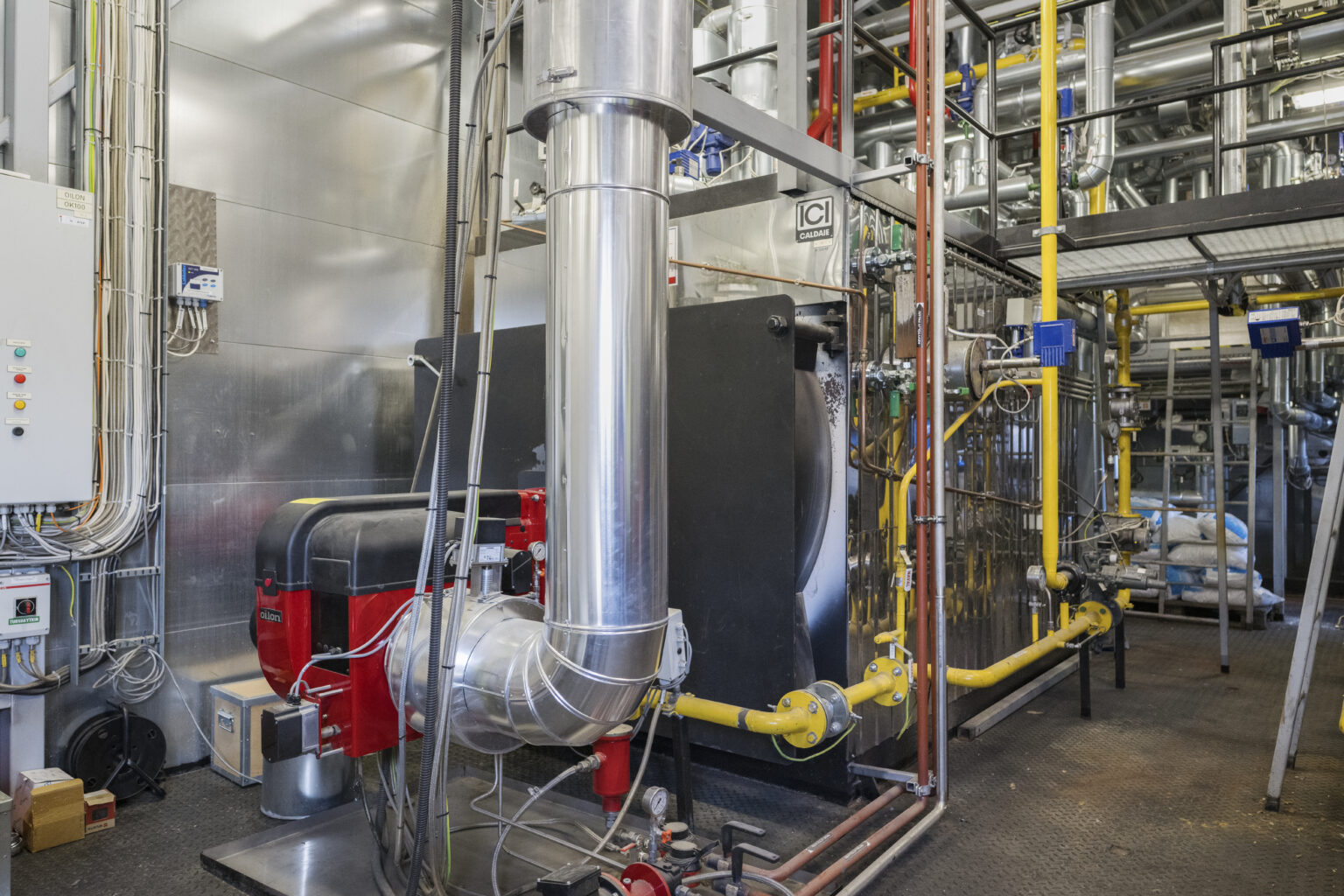
Valio outsourced energy production at its Vaarala factory to Auris well over a decade ago. What began with gas deliveries developed into a partnership that expanded a couple of years ago when Auris supplied a modern electric boiler alongside Valio’s gas boilers.
“Under normal conditions, the electric boiler produces all the heat and steam our factory needs,” says Peter Fabritius. As Valio’s Energy Manager, he has worked closely with Auris Energy for 12 years.
The gas boilers are used only when they can produce the steam and heat Valio needs more cheaply than electricity.
Automation selects the most cost-effective energy source
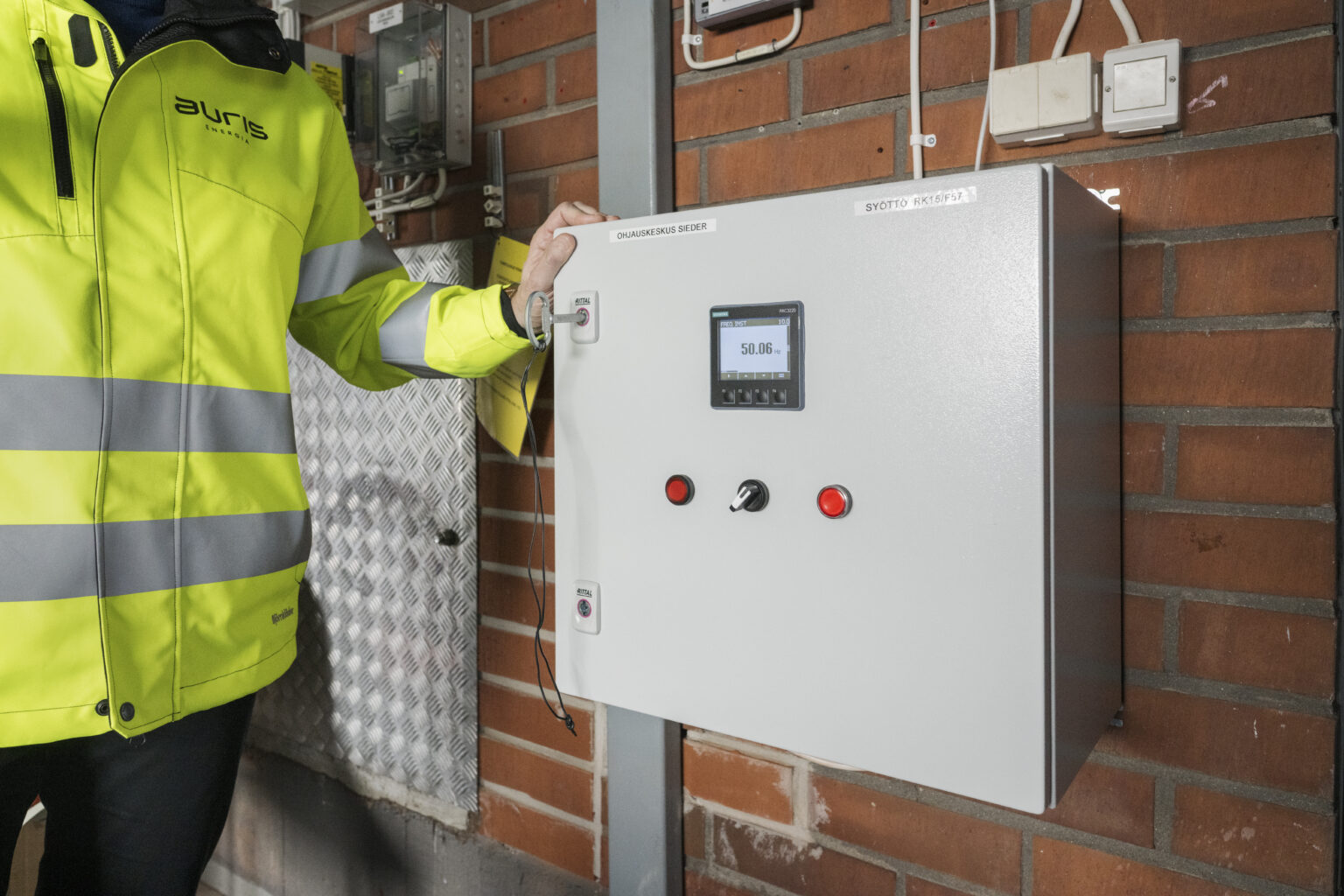
We meet Auris’s Technical Manager, Taisto Uimonen, beside the electric boiler’s control panel. He is responsible for the day-to-day operation of Valio’s energy system.
“The automation tells this control system whether to use the electric or gas boiler. The panel shows the same information as the automation: alarms, pressures, levels and the load – how much the boiler is being used. It can be used to control the boiler manually in the same way as the automation,” Uimonen says, pointing to the panel.

In Uimonen’s office, we see the automation control centre, which controls the boilers according to fluctuations in gas and electricity prices. It receives its input from an automation system that monitors energy prices in real time.
Electricity market conditions can change quickly. Valio may, for example, have planned to produce energy cost-effectively with electricity on a given day. If the electricity price suddenly rises, gas becomes the better choice. The partnership between Auris and Valio therefore enables Valio to optimise its energy procurement costs significantly.
Reserve markets balance the energy system
As wind and solar account for a growing share of Finland’s electricity generation, output fluctuates much more than in previous decades. The electricity system therefore needs increasingly frequent adjustments to consumption. Fingrid’s reserve markets balance rapid market changes.
“Guided by our automation system, we switch quickly from electricity to gas while offering demand flexibility to electricity markets. Previously, changes took place hourly, but since 4 March they have taken place in 15-minute periods,” Fabritius says.
There are five reserve markets. Valio participates in the mFRR market (manual Frequency Restoration Reserve).
“On the mFRR market, accepted downward and upward regulation bids generate several hundred euros per hour per megawatt-hour. Money can be earned in both upward and downward regulation,” says Auris Energy Key Account Manager Mika Kannisto.
A bid submitted to the market is naturally always higher than Valio’s energy production cost: reserve market bids must not be too low. Automation supplied by Auris’s aggregator partner ensures this does not happen.
Even coffee makers could join reserve markets
According to Kannisto, Valio is an excellent example of how an industrial company can participate in reserve markets.
“Reserve market participation is possible wherever electrical power can be adjusted up or down without disrupting the facility’s operations.”
In addition to industry, this can be done with electric boilers in residential buildings, for example, or in greenhouses where lighting can be switched off for a few tens of minutes.
“There is enormous potential in reserve markets. Technology in this field is developing very quickly. Soon, even coffee makers could participate in a market without us even knowing,” Kannisto suggests.
Reserve market participation forms part of the energy service Auris provides to Valio under a long-term lifecycle agreement.
Valio, Auris and Auris’s aggregator partner share the benefits generated by reserve markets.
“The reserve market revenue will cover the system’s small initial investment quite quickly. After that, the system will generate net income,” Kannisto explains.
Three principles of energy procurement
Both reserve market participation and the energy services partnership with Auris fit well with Valio’s three energy procurement principles.
Availability comes first: Valio needs steam and heat for production at all times. Without them, the factory stops and business comes to a halt.
“Cost-effectiveness is our second key principle. We cannot remain competitive if we cannot serve our owners – the dairy farmers – efficiently,” Fabritius says.
In recent years, sustainability has become the third cornerstone of Valio’s operations. Without responsible conduct, the company would not stay in the market for long.
“Our energy partnership with Auris does not compromise these principles. Availability is guaranteed and operations are cost-effective. Participating in reserve markets supports our sustainability goals by helping maintain the balance of Finland’s electricity system.”
An energy system well suited to reserve markets
Discussions between Valio and Auris about bringing the electric steam boiler into Fingrid’s reserve markets began in late 2023.
At that time, Auris’s experts identified that Valio’s energy system was well suited to the reserve market.
Auris investigated the technical feasibility of Valio’s boilers participating before Valio made its decision.
“Among other things, we investigated which reserve markets suited the boilers and what effects participation would have on the plant’s operations. In practice, reducing the electric boiler’s output by one megawatt does not affect steam production, because the gas boilers take over. For Valio, the priority is to guarantee heat and steam production every minute, even while the electric boiler participates in reserve markets,” Kannisto says.
The decision to participate was not made overnight.
“I want to know what I am doing,” Fabritius says. “For a mechanical engineer like me, genuinely understanding reserve markets is quite challenging. You need to understand what happens in the system’s processes hour by hour, what the balancing electricity system is and how reserve market revenue is generated. This is a pilot project for us, and Auris has given us all the help we need.”
Joining the reserve markets required only minor modifications, with no major equipment installations. The aggregator brought its own automation control unit to Valio and connected it to the boiler controls.
“The system runs automatically, without manual control. Auris and our other partners have worked well together to put a functioning system into operation,” Fabritius says.
A responsible decision through close cooperation
The system enabling reserve market participation was built in autumn 2024 and successfully commissioned at the end of the year.
Fabritius believes the system will fulfil its objectives in the future.
“When we take sustainability actions, they must also make commercial sense,” Fabritius says.
According to Fabritius, reserve market participation requires close cooperation with several different parties and a trusted partner to lead the project.
“Auris has been an important partner responsible for the project. We work closely together, and Auris’s people are always easy to approach,” Fabritius says.
Some objectives have already been achieved. Reserve market participation helps maintain transmission grid frequency, ensuring stable grid operation. Reserve markets mean that transmission system operator Fingrid does not need to make additional investments in maintaining the electricity system, as consumption can adjust to production in both directions.
Read more about Valio and Auris’s partnership: Factory steam production and energy optimisation – Valio – Auris Energy