Working on or near gas pipelines
Guidance for working safely near gas pipelines.
Working on or near gas pipelines
Activities that could damage natural gas pipelines are prohibited along pipeline routes. For example, excavation, rock excavation and blasting in the immediate vicinity of a natural gas pipeline are prohibited without permission from the distribution network operator.
Anyone working along a natural gas pipeline route must also establish what other structures are present in the area. The requirements of electricity legislation must also be taken into account.
Working along a natural gas pipeline route
Work along or in the immediate vicinity of a natural gas pipeline may include not only the construction of buildings but also the construction, installation, servicing and maintenance of access routes, drainage systems, water and sewer pipes, district heating pipes, electrical lines and cables, communications lines and cables, and other structures, including temporary ones.
Locating a natural gas pipeline
Gas pipelines are underground, usually at a depth of around 0.6–1.2 metres. Pipeline routes are marked with marker posts. To confirm the location of a gas pipeline, always contact the pipeline owner at least three days before excavation begins.
Notify Auris Kaasunjakelu Oy by requesting an on-site pipeline location service through verkkoselvitys.fi or kaivulupa.fi.
The gas network
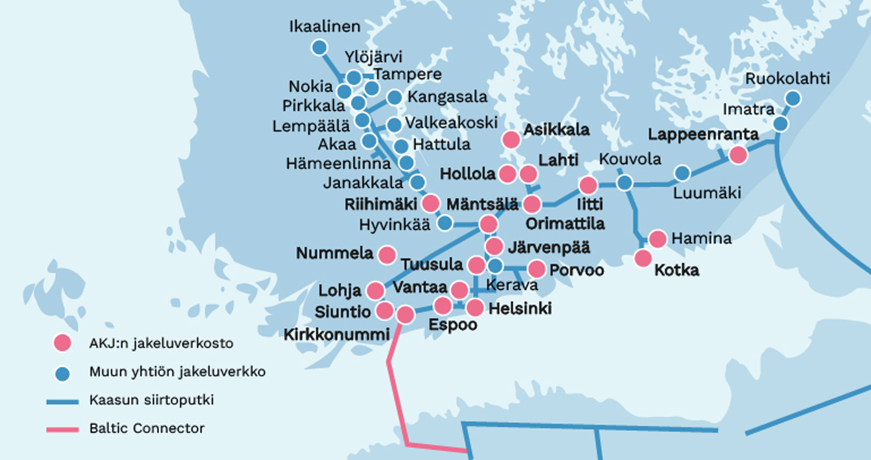
The Auris Kaasunjakelu Oy gas distribution network mainly comprises networks operating at pressures of 0.02–8 bar. Specific instructions may apply to different parts of the network and different areas. These will be explained during the on-site location visit.
These instructions apply within the gas distribution networks owned by Auris Energy: the networks of Auris Kaasunjakelu Oy and Haminan Kaasuverkko Oy.
Excavation and backfilling
The distribution network operator will show the exact location of the pipeline. Excavation must be planned in advance. Take particular care during excavation, especially when exposing and backfilling a gas pipeline, and follow the instructions provided by the pipeline operator.
Excavation within five metres of an 8-bar distribution network requires excavation supervision for the duration of the work.
Crossings beneath pipelines
Crossings, such as directional drilling and pipe jacking near a gas pipeline, must always be reviewed in advance with the network operator. The review will determine the measures required, such as exposing the gas pipeline along the crossing route and the need for excavation supervision.
Blasting
For blasting and rock excavation within 30 metres of a natural gas pipeline, the person responsible for the work must contact the distribution network operator to obtain a work permit.
Construction
When planning underground infrastructure or above-ground structures near a gas pipeline, take account of the minimum separation distances required for the pipeline. These depend on the pressure of the pipeline in the area and the protective measures in place.
Traffic and storage along a gas pipeline route
Crossing a gas pipeline with heavy machinery requires permission from the pipeline operator. In soft ground, crossing points must be reinforced in a manner approved by the pipeline operator. Storing timber or similar materials along the pipeline route within five metres of the pipeline is prohibited without permission from the pipeline operator.
What to do if a gas pipeline is damaged
- Switch off the engine of the machine and leave the machine.
- Prevent bystanders from entering or approaching the damaged area.
- Prevent sparks and the use of naked flames at the site (smoking, vehicles).
- In an emergency, call the emergency number 112.
Emergency pipeline location service: Verkkoselvitys, 075 7580 700
Fault and damage reports: Auris Kaasunjakelu, 24/7, 0800 177 955
Related images